
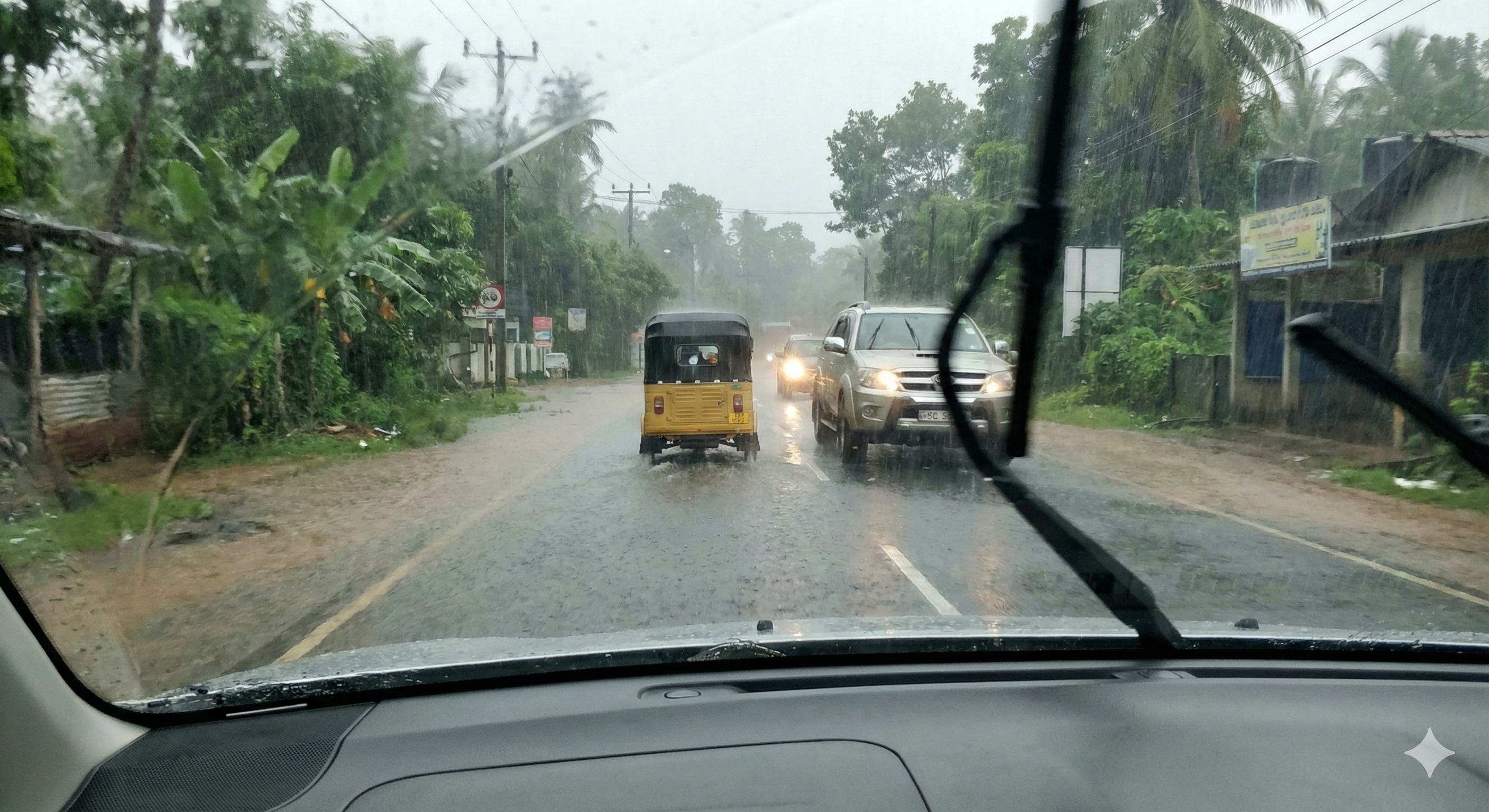
Last year’s monsoon taught me some hard lessons about driving in Sri Lankan rain. After nearly hydroplaning on the Colombo-Kandy road and watching my neighbor’s car get flooded in his own garage, I decided to put together everything I’ve learned about staying safe during our rainy season.
The Reality of Monsoon Driving in Sri Lanka
Let me be honest - driving in Sri Lankan monsoons is nothing like driving in light rain. Within minutes, roads can transform into rivers, visibility drops to almost zero, and that pothole you’ve been avoiding for months suddenly becomes invisible and twice as dangerous.
I remember one evening last October, driving home from work. The rain started as a drizzle, and within ten minutes, I couldn’t see the car in front of me. The Road near my house had turned into a small lake. That’s when I realized I needed to completely change how I approach monsoon driving.
Before the Rain Even Starts
Check Your Tires (Seriously, Do It Now)
I used to think “tires are tires” until I nearly lost control on a wet road. The tread depth makes a massive difference in rain. Here’s a simple test my mechanic taught me: take a Rs. 10 coin and insert it into the tire groove. If you can see the entire coin, your tires are too worn.
My friend Sandun learned this the hard way. He was driving on worn tires during heavy rain near Kaduwela, and his car just kept sliding. He wasn’t speeding or being reckless - the tires simply couldn’t grip the wet road. Thankfully, he only hit a curb, but it could have been much worse.
What to do:
- Check tire pressure monthly (it should match the sticker inside your driver’s door)
- Look for uneven wear patterns
- Replace tires when tread depth is low
- Don’t mix old and new tires on the same axle
Your Wipers Are More Important Than You Think
I used to ignore that annoying squeaking sound from my wipers. “They still work,” I’d tell myself. Then came a heavy downpour on the Southern Expressway, and I realized my wipers were just smearing water across the windscreen instead of clearing it.
Good wipers cost around Rs. 2,000-6,000 for a decent pair. That’s nothing compared to the accident they might prevent. Replace them every year before monsoon season starts.
The Stuff Nobody Tells You About
Keep these in your car during monsoon season:
- A small towel (for wiping inside fog)
- Extra phone charger (in case you get stuck)
- Bottle of water and some snacks
- Flashlight with working batteries
- Basic first aid kit
I also keep a pair of old slippers in my boot. Sounds silly, but when you need to step out in flooded water, you’ll thank me.
When the Rain Starts
Slow Down (No, Slower Than That)
Everyone says “slow down in rain,” but what does that actually mean? Here’s what I do: whatever speed I normally drive, I reduce it by at least 30%. If I usually do 60 km/h on a city road, I drop to 40 km/h in rain.
Why? Because stopping distance on wet roads is nearly double what it is on dry roads. That car that you could normally stop for in 20 meters? Now you need 40 meters. And if there’s standing water? Even more.
The Two-Second Rule Becomes Four
You know how they teach you to maintain a two-second gap from the car in front? In rain, make it four seconds. Pick a landmark (a sign, a tree, whatever), and when the car ahead passes it, count “one thousand one, one thousand two, one thousand three, one thousand four” before you reach it.
I know it feels like you’re driving too slowly and everyone will overtake you. Let them. I’d rather arrive late than not arrive at all.
Reading the Road
This is something I learned from an experianced driver, who drove a bus for 30 years. He taught me to “read” the water on the road:
Light ripples: Usually safe, just water on the surface Smooth, mirror-like surface: Could be deep - approach with extreme caution Fast-moving water: Never drive through it, even if it looks shallow Muddy, brown water: Probably has debris underneath
Last monsoon, I saw a car try to drive through what looked like shallow water. The water was actually knee-deep, and the car stalled right in the middle. The driver had to be rescued. Don’t be that person.
Dealing with Flooded Roads
The 6-Inch Rule
If water is deeper than 6 inches (about the height of your foot), don’t risk it. I don’t care if you see other cars going through. Your car’s air intake is probably lower than you think, and once water gets in there, your engine is done.
If You Must Cross
Sometimes you have no choice. Here’s what I do:
- Watch other cars go through first (especially larger vehicles)
- Note the deepest point
- Shift to first gear (or Low if automatic)
- Drive slowly but steadily - don’t stop in the middle
- Keep engine revs up (around 2000-3000 RPM)
- Once through, gently tap brakes several times to dry them
The key is steady speed. Too fast and you create a wave that floods your engine. Too slow and you might stall.
When Visibility Drops to Zero
This happened to me on the Kandy road last year. The rain was so heavy I literally couldn’t see the road markings. Here’s what saved me:
Turn on ALL Your Lights
Not just headlights - turn on fog lights if you have them, and definitely turn on hazard lights if visibility is really bad. Some people say hazard lights are only for emergencies, but I consider zero visibility an emergency.
Follow the Tail Lights
If you can see the car ahead, use their tail lights as a guide. But maintain that four-second gap! Don’t get so close that you can’t stop if they brake suddenly.
Pull Over If Necessary
There’s no shame in pulling over and waiting. I’ve done it multiple times. Find a safe spot (not on the road shoulder if possible), turn on hazard lights, and wait for the heavy rain to pass. Most intense downpours only last 15-20 minutes anyway.
The Hydroplaning Scare
Hydroplaning is when your tires lose contact with the road and you’re essentially skiing on water. It’s terrifying. It happened to me once at about 70 km/h on the expressway, and for a few seconds, my steering did absolutely nothing.
How to Know You’re Hydroplaning
- Steering feels light and unresponsive
- Engine sounds like it’s revving higher
- Car feels like it’s floating
What to Do
This is counterintuitive, but:
- Don’t brake hard
- Don’t turn the wheel sharply
- Ease off the accelerator gently
- Keep the wheel straight
- Wait for traction to return
I know your instinct is to brake hard, but that can make things worse. Just ease off the gas and let the car slow down naturally.
After the Rain
Check for Damage
After driving through any significant water, I always check:
- Under the car for debris
- Brake performance (tap them a few times)
- Any unusual sounds or smells
- Dashboard warning lights
Dry Your Brakes
This is simple but important. After driving through water, gently apply your brakes while driving slowly. This creates friction that dries them out. Otherwise, your first real stop might be less effective than you expect.
Special Situations
Driving at Night in Rain
This is the worst combination. Visibility is already bad from rain, and now it’s dark too. My rule: if I don’t absolutely have to drive, I don’t. But if I must:
- Clean your windscreen inside and out before starting
- Use low beams, not high beams (high beams reflect off rain and blind you)
- Reduce speed even more than daytime rain driving
- Watch for pedestrians wearing dark clothes
Motorcycles and Three-Wheelers
They’re everywhere in Sri Lankan traffic, and rain makes them even more unpredictable. Give them extra space. They can lose traction more easily than cars, and their braking distance is longer in rain.
I always assume they might swerve or brake suddenly. It’s kept me out of several potential accidents.
What About Hybrid and Electric Cars?
I drive a hybrid, and people always ask if it’s safe in floods. The short answer: they’re actually quite safe in rain, but not in floods.
The electrical systems are well-sealed, and I’ve driven through plenty of rain without issues. But deep water? No way. The battery pack is usually under the floor, and while it’s protected, I’m not risking it.
My Monsoon Driving Checklist
Before monsoon season, I go through this list:
- Check tire tread depth and pressure
- Replace wiper blades if needed
- Test all lights (including fog lights)
- Check brake performance
- Clean windscreen inside and out
- Stock emergency supplies
- Review insurance coverage for flood damage
During monsoon season:
- Check weather before long trips
- Allow extra travel time
- Keep fuel tank above half (in case you get stuck)
- Charge phone fully
- Tell someone your route and expected arrival time
Real Talk: When to Just Stay Home
Sometimes the best driving decision is not to drive at all. I stay home when:
- Weather warnings are issued
- Roads in my area are already flooding
- Visibility is extremely poor
- I don’t have an urgent reason to travel
Last year, I skipped a friend’s party because the weather was terrible. He gave me grief about it until three other guests called to say they were stuck in traffic for hours due to flooding. Sometimes being “boring” is being smart.
Learning from Mistakes
I’ve made plenty of mistakes driving in monsoons:
- Drove too fast and hydroplaned (scary but learned my lesson)
- Tried to cross water that was too deep (stalled but managed to restart)
- Didn’t maintain my wipers (couldn’t see anything in heavy rain)
- Followed too closely (nearly rear-ended someone)
Each mistake taught me something. The key is learning without having a serious accident.
Final Thoughts
Monsoon driving in Sri Lanka requires respect for the conditions and a willingness to adjust your normal driving habits. It’s not about being the fastest or the bravest - it’s about getting home safely.
Remember:
- Slow down more than you think necessary
- Maintain larger following distances
- Don’t drive through deep water
- Pull over if visibility is too poor
- Keep your car maintained
And most importantly: it’s okay to be cautious. It’s okay to drive slowly. It’s okay to pull over and wait. It’s okay to cancel plans if the weather is too bad.
Your safety is worth more than being on time or looking brave.
Stay safe out there, and may your monsoon season be uneventful!