
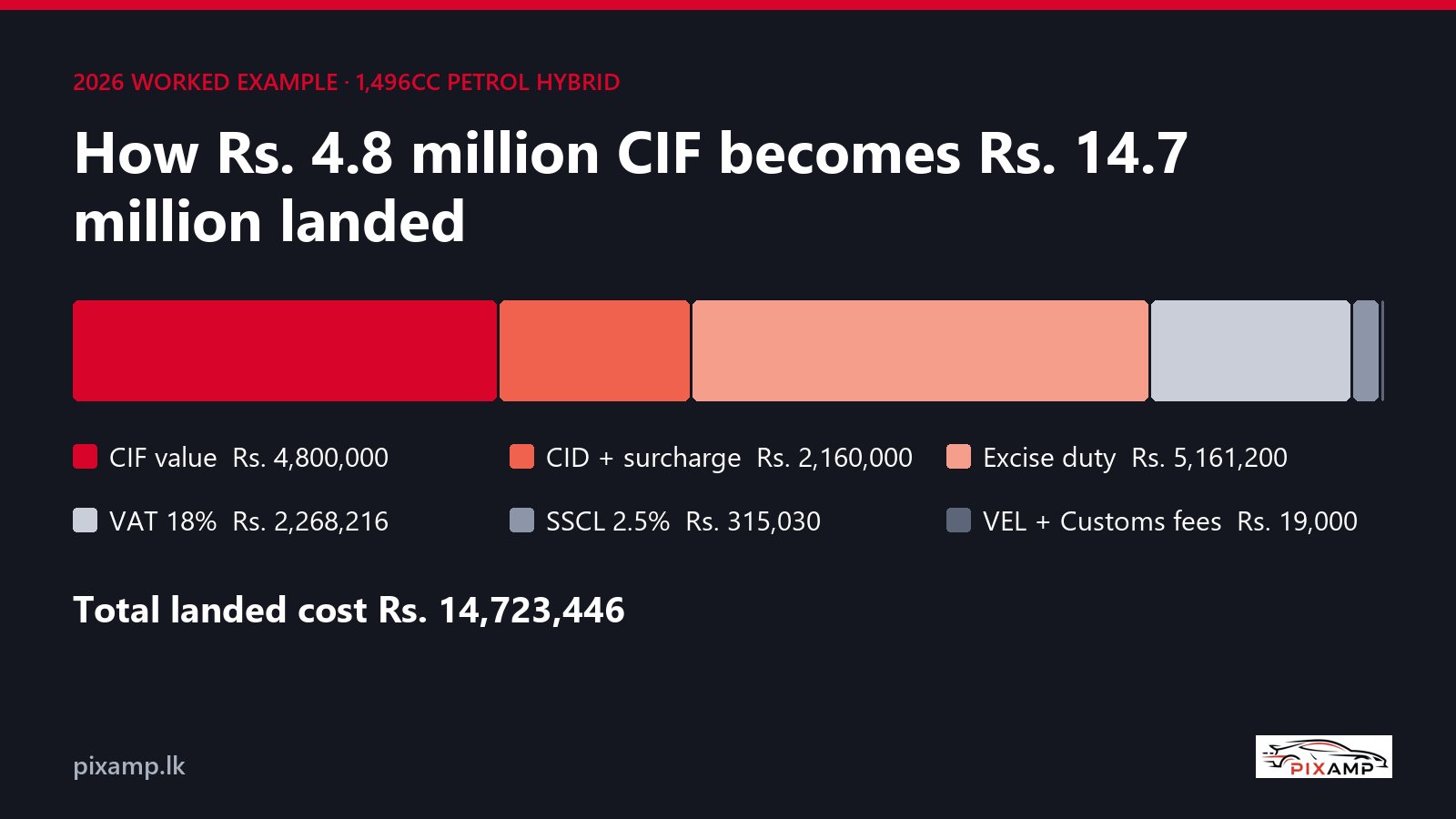
Most people see only the final number when they ask how much it costs to import a vehicle into Sri Lanka. That makes it hard to compare cars or to understand why two vehicles with the same price end up costing very different amounts. This guide works through a complete example, one tax at a time, using the same method as the PiXAMP import calculator.
The example vehicle
We will use a typical family hatchback:
- Fuel type: petrol hybrid (not plug-in)
- Engine capacity: 1,496cc
- Year of manufacture: 2024
- CIF price: JPY 2,400,000 (cost, insurance and freight to Colombo)
- Exchange rate: Rs. 2.00 per yen
The exchange rate here is a round number chosen to make the arithmetic easy to follow. When you calculate for a real vehicle, use the current rate. Everything else below follows from these five inputs.
Step 1: Convert the CIF value to rupees
All Sri Lankan import taxes are based on the CIF value in rupees:
CIF (LKR) = JPY 2,400,000 × 2.00 = Rs. 4,800,000
Step 2: Customs Import Duty (CID) and the surcharge
The base Customs Import Duty on motor cars is 30% of CIF, and a surcharge of 50% of that duty applies on top of it:
- CID: 30% × Rs. 4,800,000 = Rs. 1,440,000
- Surcharge: 50% × Rs. 1,440,000 = Rs. 720,000
- Total CID: Rs. 2,160,000 (an effective 45% of CIF)
Step 3: Excise Duty
Excise Duty is the largest single tax on most vehicles, and it is not based on the price at all. For petrol and diesel cars it is a rate per cubic centimetre that depends on the fuel type and engine size bracket.
A petrol hybrid from 1,300cc up to 1,499cc pays Rs. 3,450 per cc:
Excise Duty = 1,496 × Rs. 3,450 = Rs. 5,161,200
Notice that this one tax is larger than the CIF value of the car. That is why engine size matters so much: the same car with a 1,500cc engine would move into the next bracket and pay a higher rate on every cc.
Step 4: Luxury Tax
Luxury Tax applies only when the CIF value is above a threshold that depends on the fuel type. For petrol hybrids the threshold is Rs. 5,500,000, and 80% is charged on the amount above it.
Our CIF of Rs. 4,800,000 is below the threshold, so Luxury Tax = Rs. 0.
If the same car had a CIF of Rs. 7,000,000 instead, Luxury Tax would be 80% × (Rs. 7,000,000 − Rs. 5,500,000) = Rs. 1,200,000.
Step 5: VAT and SSCL
VAT (18%) and the Social Security Contribution Levy (SSCL, 2.5%) are both charged on the same base, which is built from the CIF value plus a 10% uplift, the total CID and the Excise Duty:
- CIF × 1.10 = Rs. 5,280,000
- Total CID = Rs. 2,160,000
- Excise Duty = Rs. 5,161,200
- VAT base = Rs. 12,601,200
Then:
- VAT: 18% × Rs. 12,601,200 = Rs. 2,268,216
- SSCL: 2.5% × Rs. 12,601,200 = Rs. 315,030
Because the base includes CID and Excise Duty, VAT and SSCL are effectively charged on taxes as well as on the vehicle. This compounding is a big part of why landed costs grow so quickly.
Step 6: Fixed charges
Two small fixed charges complete the government side:
- Vehicle Entitlement Levy (VEL): Rs. 15,000
- COM / EXM / SEL (computer, examination and seal charges): Rs. 4,000
Step 7: Add it all up
| Item | Amount (Rs.) |
|---|---|
| CIF value | 4,800,000 |
| CID + surcharge | 2,160,000 |
| Excise Duty | 5,161,200 |
| Luxury Tax | 0 |
| VAT (18%) | 2,268,216 |
| SSCL (2.5%) | 315,030 |
| VEL | 15,000 |
| COM / EXM / SEL | 4,000 |
| Total government taxes | 9,923,446 |
| Total landed cost | 14,723,446 |
So a hybrid with a CIF of Rs. 4.8 million costs about Rs. 14.7 million once it clears Customs. The taxes alone are more than twice the CIF value.
On top of this you will usually pay bank charges for the letter of credit, a clearing agent’s fee and, if you use one, an importer’s commission. The PiXAMP calculator lets you add these as optional costs.
What changes the result the most
Using the same CIF value of Rs. 4,800,000 and a 2024 manufacture year, here is how the fuel type and engine size change the total landed cost:
| Vehicle | Excise Duty (Rs.) | Total landed cost (Rs.) |
|---|---|---|
| Petrol, 996cc | 2,440,200 | 11,444,641 |
| Petrol hybrid, 1,496cc | 5,161,200 | 14,723,446 |
| Petrol, 1,496cc | 6,657,200 | 16,526,126 |
| Electric, 80 kW | 2,896,000 | 11,993,880 |
| e-SMART hybrid (petrol), 80 kW | 3,475,200 | 12,691,816 |
The CIF value is the same in every row, yet the landed cost ranges from about Rs. 11.4 million to Rs. 16.5 million. The difference comes almost entirely from Excise Duty, and from VAT and SSCL being charged on top of it.
A note on vehicle age
For electric and e-SMART vehicles, Excise Duty also depends on age. Our 80 kW electric car, made in 2024, pays Rs. 36,200 per kW (Rs. 2,896,000). The same car made in 2022 falls into the over-three-years band and pays Rs. 72,400 per kW (Rs. 5,792,000), which pushes the landed cost up to Rs. 15,483,560.
The PiXAMP calculator works out age from the year of manufacture. Customs may assess age more precisely, for example from the date of manufacture or first registration, so a vehicle close to a boundary can fall into a different band. Check this with your clearing agent before you buy.
Try it with your own numbers
Every figure in this article can be reproduced with the PiXAMP vehicle import tax calculator. Enter your vehicle’s CIF price, the current exchange rate, the fuel type, engine capacity and year, and it shows each tax line by line. When you know the landed cost, the finance calculator shows what the monthly lease installment would be.
These figures are estimates based on the gazetted rates used by PiXAMP at the time of writing. Tax rates change; always confirm the final amount with Sri Lanka Customs or a licensed clearing agent before committing to a purchase.