
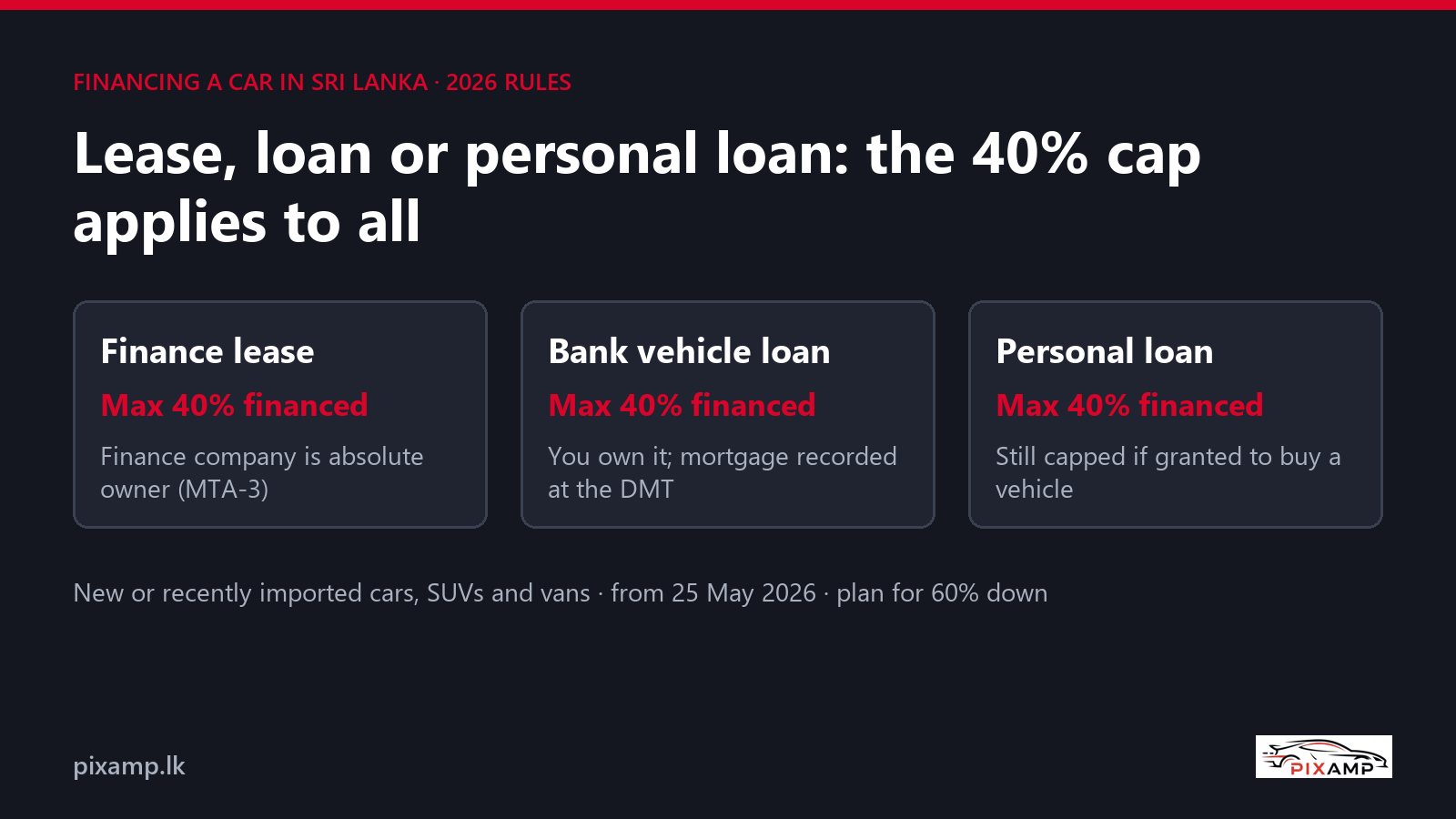
When you finance a car in Sri Lanka you usually choose between a lease from a finance or leasing company, a vehicle loan from a bank, or a personal loan. They differ in who owns the car while you pay, what is recorded at the Department of Motor Traffic (DMT), and how the cost is quoted. Since May 2026 they also share one important rule: how much any of them may lend.
The rule that applies to all of them: 40% for new imports
From 25 May 2026, CBSL Act Directions No. 01 of 2026 cap credit for buying a motor car, SUV, van or three-wheeler at 40% of the vehicle’s value if it is unregistered or has been registered in Sri Lanka for less than one year (60% if it has been registered in Sri Lanka for more than one year).
The Direction applies to licensed banks, licensed finance companies and registered finance leasing establishments, and it defines credit broadly: “finance leases, hire purchase facilities, vehicle loans and any other type of credit facilities or accommodation granted for the purpose of purchase or utilisation of vehicles”. It also says these institutions “shall not grant credit facilities for the purpose of purchase or utilisation of motor vehicles” other than within those limits.
In practice, that means switching from a lease to a loan does not let you borrow more for a newly imported car. Whichever product you choose, plan for a down payment of at least 60%. Letters of credit opened before 25 May 2026 may still qualify for the earlier, higher limits; ask your lender.
How the options differ
| Finance lease | Hire purchase | Bank vehicle loan | Personal loan | |
|---|---|---|---|---|
| Typical lender | Leasing or finance company (some banks) | Finance company | Bank | Bank or finance company |
| Who owns the car while you pay | The finance company, as absolute owner | The lender, until the last installment | You, with the vehicle mortgaged to the bank | You |
| What the DMT records | The finance company as absolute owner (form MTA-3), you as registered owner | Depends on the agreement; ask the lender | You as owner, with the mortgage registered (copy of the mortgage deed) | You as owner |
| Covered by the 40% cap? | Yes | Yes | Yes | Yes, if granted for buying a vehicle |
| Comprehensive insurance as a condition | Usually | Usually | Usually | Depends on the lender |
The DMT’s first-registration document list asks for “the relevant MTA-3” for registration of absolute ownership, and “a copy of the mortgage deed” for registration with a mortgage. That is the paperwork difference between a lease and a mortgaged loan.
What ownership means for you
- Under a lease, the finance company is the absolute owner until the final installment. You use and maintain the car, but selling it or transferring it before the lease ends needs the finance company’s involvement, and ownership is transferred to you only after you settle the lease.
- With a mortgaged bank loan, the car is yours, but the mortgage stays recorded until the loan is repaid.
- With a personal loan, the car is not pledged to the lender. Personal loans are usually not secured on the vehicle, so ask how that affects the rate you are offered, and how the bank classifies the loan: a loan granted to buy a vehicle is still subject to the cap.
Comparing the real cost
The product name matters less than three numbers: the interest rate on a reducing-balance basis, the fees, and the term. For a newly imported car with a landed cost of Rs. 14,723,446, financed at the 40% maximum (Rs. 5,889,378.40) over 5 years, here is how the installment changes with the rate:
| Annual rate (reducing balance) | Monthly installment (Rs.) | Total interest (Rs.) |
|---|---|---|
| 12% | 131,005.97 | 1,970,979.78 |
| 14% | 137,035.53 | 2,332,753.64 |
| 16% | 143,218.24 | 2,703,716.02 |
These rates are examples, not market quotes. If one offer is a lease at 14% and another is a personal loan at 16%, the personal loan costs about Rs. 371,000 more in interest over five years on this amount, before fees.
Watch the rate basis
Leases are sometimes quoted as a flat rate, which charges interest on the original amount for the whole term. A 14% flat rate on Rs. 5,889,378.40 over 5 years costs Rs. 4,122,564.88 in interest, against Rs. 2,332,753.64 at 14% reducing balance: nearly Rs. 1.8 million more for the same headline number. Convert every offer to a reducing-balance rate before you compare; the PiXAMP finance calculator uses the reducing-balance method.
Questions to ask every lender
- What is the maximum you can finance for this vehicle, and on what value? The Direction uses market value; for a reconditioned car this can be the Customs clearance valuation or the dealer’s invoice value.
- Is the rate flat or reducing balance, and is it fixed for the whole term?
- What are all the one-off charges? Documentation, valuation, processing and any registration costs.
- Who will be recorded at the DMT, and when does ownership pass to me?
- What does early settlement cost?
- What insurance is required, and can I choose the insurer?
Putting it together
- Estimate the landed cost with the import tax calculator.
- Plan for at least 60% down on a new import, whichever product you use.
- Compare offers on the reducing-balance rate plus all fees, then check ownership and early-settlement terms.
- Model the installment in the finance calculator, and read the true cost of financing an imported car for how the term and down payment change the total.
Sources
- Central Bank of Sri Lanka, CBSL Act Directions No. 01 of 2026 (maximum loan-to-value ratios for motor vehicles, effective 25 May 2026), linked from the CBSL press release of 24 May 2026.
- Department of Motor Traffic, First Registration – Vehicle (MTA-3 for absolute ownership; mortgage deed for registration with a mortgage).
This guide is general information, not financial advice. Terms differ between lenders; get every offer in writing.