
Electric cars are taxed very differently from petrol cars in Sri Lanka. Excise duty is charged on the power of the electric motor, not on engine capacity or price, and the rate depends on how old the car is. Get the motor rating or the age band wrong and your estimate can be out by millions of rupees.
This guide explains the rules for a normal electric car charged from the grid, with worked examples at the rates in force in October 2026.
Which cars count as “electric”
These rules apply to cars with only an electric motor for propulsion, charged from an external source such as the national grid (HS codes 8703.80.31 to 8703.80.44).
They do not cover:
- Ordinary hybrids such as a Honda Vezel, which pay excise per cc of engine capacity.
- e-SMART hybrids, where a petrol or diesel engine only charges the battery. They also pay per kW, but at different rates (see hybrid, e-SMART or petrol).
- Plug-in hybrids, which have their own classification.
Excise duty: rupees per kW of motor capacity
Gazette No. 2421/42 (31 January 2025) sets electric car excise per kW of motor capacity, in four brackets. Each bracket is worded “not exceeding”, so a 50 kW motor falls in the first bracket and a 51 kW motor in the second.
| Motor capacity | Not more than 1 year old | Over 1, up to 3 years old |
|---|---|---|
| Not exceeding 50 kW | Rs. 18,100 / kW | Rs. 36,200 / kW |
| Exceeding 50 kW, not exceeding 100 kW | Rs. 24,100 / kW | Rs. 36,200 / kW |
| Exceeding 100 kW, not exceeding 200 kW | Rs. 36,200 / kW | Rs. 60,400 / kW |
| Exceeding 200 kW | Rs. 96,600 / kW | Rs. 132,800 / kW |
The rate applies to every kW of the motor, so crossing a bracket boundary raises the duty on the whole motor, not just the extra kW. A 200 kW car pays Rs. 36,200 per kW (Rs. 7,240,000 when not more than one year old); a 201 kW car pays Rs. 96,600 per kW (Rs. 19,416,600).
What “motor capacity” means
The gazette taxes the capacity of the motors, the rated power in kW. It is not the battery size (kWh) and not the range. For a car with two motors, ask your clearing agent how the combined rating will be declared; the figure normally comes from the manufacturer’s specification and the export documents.
Age matters more than anything else
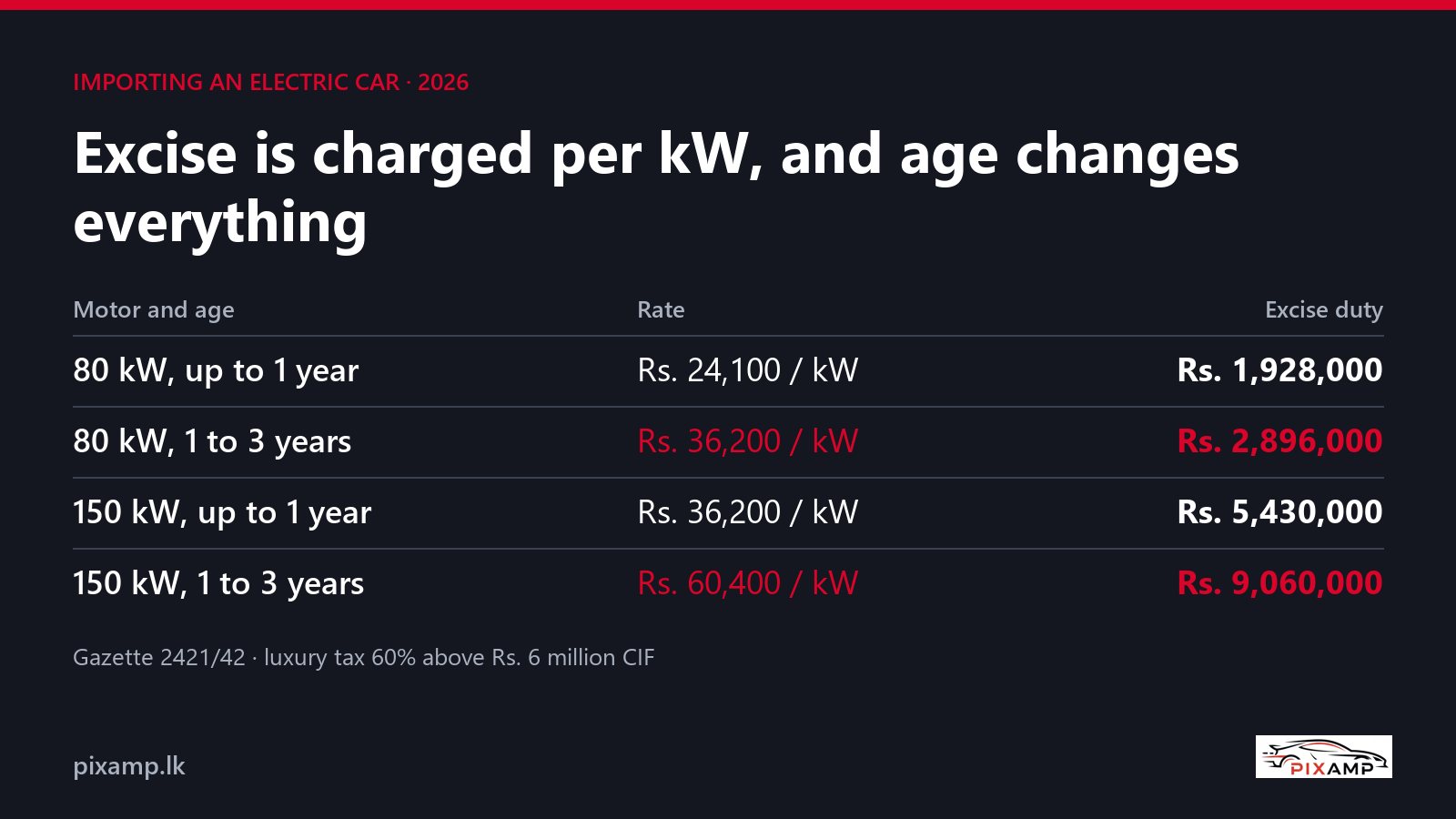
The same car can pay a very different amount depending on its age. Compare an 80 kW and a 150 kW electric car at the same CIF value of Rs. 6,500,000:
| Car | Age band | Rate | Excise duty (Rs.) | Total landed cost (Rs.) |
|---|---|---|---|---|
| 80 kW | Not more than 1 year | 24,100 / kW | 1,928,000 | 14,132,615 |
| 80 kW | Over 1, up to 3 years | 36,200 / kW | 2,896,000 | 15,299,055 |
| 150 kW | Not more than 1 year | 36,200 / kW | 5,430,000 | 18,352,525 |
| 150 kW | Over 1, up to 3 years | 60,400 / kW | 9,060,000 | 22,726,675 |
For the 150 kW car, being over one year old adds more than Rs. 4.3 million to the landed cost. If a car is close to its first birthday, ask your agent how Customs will determine its age (for example from the date of manufacture or first registration) before you open a letter of credit.
Cars over three years old
Gazette 2421/42 also lists rates for electric cars more than three years old (Rs. 48,300 to Rs. 144,900 per kW). However, the 2026 Sri Lanka Customs tariff marks those classifications “LS”: Import Control License suspended until further notice. In practice, check with your agent before considering any car more than three years old; the same mark appears on other cars over three years old.
Luxury tax: Rs. 6 million threshold, 60%
Under Gazette 2421/41, luxury tax on electric cars applies only to the part of the CIF value above Rs. 6,000,000, at 60%. At a CIF of Rs. 6,500,000 that is 60% × 500,000 = Rs. 300,000. Petrol hybrids, by comparison, have a Rs. 5,500,000 threshold and an 80% rate.
The other taxes are the same as for any car
- Customs Import Duty: 30% of CIF, plus the 50% surcharge on that duty until 31 December 2026 (Gazette 2501/88), unless your letter of credit qualifies for the exemption.
- VAT 18% and SSCL 2.5%, both on CIF × 1.10 + CID + surcharge + excise.
- VEL Rs. 15,000 and Customs fees (COM / EXM / SEL) Rs. 4,000.
Worked example: an 80 kW electric car, not more than one year old
CIF value Rs. 6,500,000:
| Item | Amount (Rs.) |
|---|---|
| CIF value | 6,500,000 |
| CID 30% + 50% surcharge | 2,925,000 |
| Excise duty (80 kW × 24,100) | 1,928,000 |
| Luxury tax (60% of 500,000) | 300,000 |
| VAT 18% | 2,160,540 |
| SSCL 2.5% | 300,075 |
| VEL + Customs fees | 19,000 |
| Total landed cost | 14,132,615 |
Electric, e-SMART or hybrid at the same price
At the same CIF value of Rs. 6,500,000, for 2026 models:
| Car | Excise duty (Rs.) | Luxury tax (Rs.) | Total landed cost (Rs.) |
|---|---|---|---|
| Electric, 80 kW | 1,928,000 | 300,000 | 14,132,615 |
| e-SMART hybrid (petrol), 80 kW | 3,277,600 | 300,000 | 15,758,883 |
| Petrol hybrid, 1,496cc | 5,161,200 | 800,000 | 18,528,621 |
At this price, the electric car costs about Rs. 4.4 million less to land than a 1,496cc petrol hybrid, mainly because of lower excise and the higher luxury tax threshold.
Before you buy
- Get the motor capacity in kW from the manufacturer’s specification, not the battery size.
- Confirm the car’s age as Customs will see it, and stay well inside the one-year or three-year boundary if you can.
- Check whether your letter of credit date and shipping date keep you inside the surcharge exemption.
- Run your numbers in the PiXAMP import tax calculator: choose Electric and enter the motor kW.
Sources
- Gazette Extraordinary No. 2421/42 of 31 January 2025 (excise on electric vehicles) and No. 2421/41 (luxury tax), Ministry of Finance, 2025 gazettes.
- Sri Lanka Customs National Imports Tariff Guide 2026, Chapter 87 and its preamble (the “LS” mark), Sri Lanka Customs.
- Gazette Extraordinary No. 2501/88 of 13 August 2026 (surcharge until 31 December 2026), Ministry of Finance.
These figures are estimates for planning. Confirm the final amount with Sri Lanka Customs or a licensed clearing agent.