
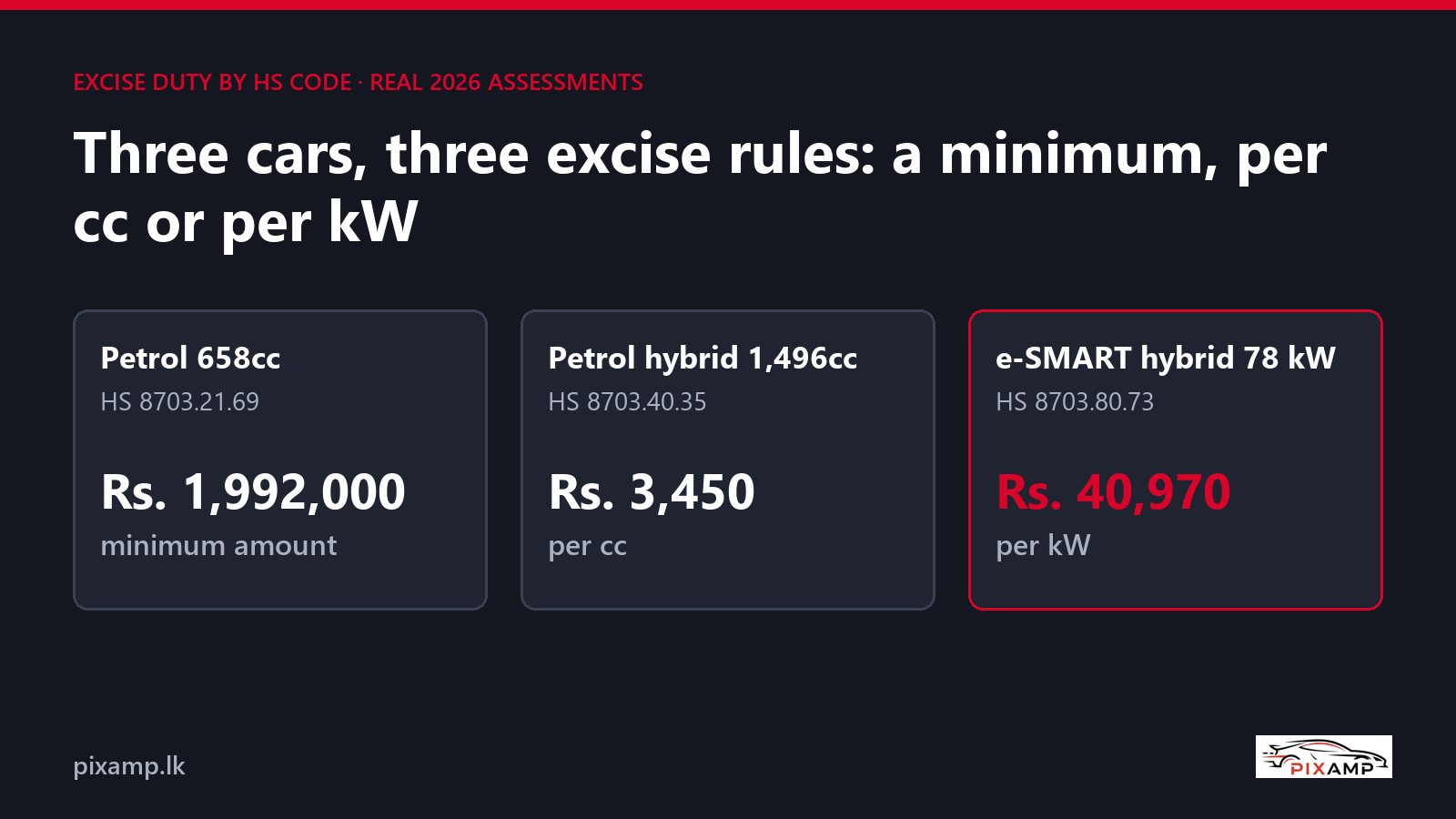
Excise duty is usually the largest single tax on an imported car in Sri Lanka, and it does not depend on the price. It depends on the vehicle’s HS code: the customs classification that says whether it is a petrol car, a hybrid, an e-SMART hybrid or an electric car. Two cars sold as “petrol hybrids” can be taxed in completely different ways.
Below are four real Customs assessments from September 2026, with identifying details removed, and the gazettes that set each rate.
Four real cars, four different excise rules
| Vehicle (2026 model) | HS code | How excise is charged | Excise duty (Rs.) |
|---|---|---|---|
| Suzuki Wagon R, petrol, 658cc | 8703.21.69 | Higher of Rs. 2,450 per cc or Rs. 1,992,000 | 1,992,000 |
| Honda Vezel, petrol hybrid, 1,496cc | 8703.40.35 | Rs. 3,450 per cc | 5,161,200 |
| Toyota Raize, petrol hybrid, 78 kW | 8703.80.73 | Rs. 40,970 per kW (not more than one year old) | 3,195,660 |
| Toyota Land Cruiser, petrol, 3,444cc | 8703.24.50 | Rs. 12,050 per cc | 41,500,200 |
The calculator reproduces each of these amounts exactly.
Small petrol cars: a minimum amount
For petrol cars under 1,000cc, excise is the higher of Rs. 2,450 per cc and a fixed Rs. 1,992,000. For the 658cc Wagon R, 658 × 2,450 = Rs. 1,612,100, so the minimum applies. The per-cc amount only overtakes the minimum above 813cc (1,992,000 ÷ 2,450 = 813.1).
Ordinary hybrids: per cc
A conventional hybrid, where the petrol engine can drive the wheels, is classified under HS 8703.40 and pays per cc of engine capacity, in brackets. The Vezel’s 1,496cc falls in the 1,300–1,500cc bracket at Rs. 3,450 per cc. Because the rate applies to every cc, crossing into the next bracket raises the duty on the whole engine, not just the extra cc.
e-SMART hybrids: per kW of motor power
Gazette 2434/04 (28 April 2025) created separate HS codes, 8703.80.71 to 8703.80.88, for vehicles described as:
“Other, with spark-ignition internal combustion piston engine only for charging the electric accumulator, not capable of being charged by plugging to external source of electric power”
In other words, a petrol (or diesel) engine that only charges the battery while an electric motor drives the wheels. These pay excise per kW of motor capacity, like electric cars, not per cc.
The Raize in our sample was described on the CUSDEC as a “petrol hybrid”, but Customs classified it under 8703.80.73 (exceeding 50 kW but not exceeding 100 kW, not more than three years old) and charged 78 kW × Rs. 40,970 = Rs. 3,195,660. If you enter a car like this as a “petrol hybrid” with its engine cc, a calculator will give the wrong excise. In the PiXAMP calculator, choose e-SMART Hybrid (Petrol Gen) and enter the motor kW.
e-SMART petrol excise rates from Gazette 2434/04 (Rs. per kW):
| Motor capacity | Not more than 1 year old | Over 1, up to 3 years old | More than 3 years old |
|---|---|---|---|
| Not exceeding 50 kW | 30,770 | 43,440 | 57,960 |
| Exceeding 50 kW, not exceeding 100 kW | 40,970 | 43,440 | 86,880 |
| Exceeding 100 kW, not exceeding 200 kW | 41,630 | 63,420 | 130,440 |
| Exceeding 200 kW | 111,090 | 139,440 | 173,880 |
Diesel e-SMART vehicles (8703.80.81–88) have their own, higher rates in the same gazette.
Electric cars: per kW, by age
Fully electric cars charged from the grid are set by Gazette 2421/42 (31 January 2025), also per kW. For a car not more than three years old:
| Motor capacity | Not more than 1 year old | Other, up to 3 years old |
|---|---|---|
| Not exceeding 50 kW | 18,100 | 36,200 |
| Exceeding 50 kW, not exceeding 100 kW | 24,100 | 36,200 |
| Exceeding 100 kW, not exceeding 200 kW | 36,200 | 60,400 |
| Exceeding 200 kW | 96,600 | 132,800 |
Above three years old the rates rise to Rs. 48,300, 72,400, 108,700 and 144,900 per kW for the same brackets.
Age matters for kW-based vehicles
For e-SMART and electric cars, the same motor can pay very different excise depending on age. An 80 kW e-SMART petrol car pays Rs. 40,970 per kW when not more than one year old, but Rs. 86,880 per kW when more than three years old, more than double. All four cars above were 2026 models assessed in 2026, so they fell in the youngest band. If your vehicle is close to a one-year or three-year boundary, ask your clearing agent how Customs will determine its age before you buy.
Luxury tax also follows the HS code
Luxury tax is charged on the CIF value above a threshold, at a rate that depends on the classification (Gazettes 2421/41 and 2434/05):
| Classification | Threshold | Rate on the excess |
|---|---|---|
| Petrol cars | Rs. 5.0 million | 100% |
| Diesel cars | Rs. 5.0 million | 120% |
| Petrol hybrids (8703.40) | Rs. 5.5 million | 80% |
| Diesel hybrids (8703.50) | Rs. 5.5 million | 90% |
| e-SMART hybrids (8703.80.7x / .8x) | Rs. 6.0 million | 60% |
| Electric cars (8703.80.3x / .4x) | Rs. 6.0 million | 60% |
From our sample: the Land Cruiser’s CIF of Rs. 12,775,459 was Rs. 7,775,459 over the petrol threshold, so at 100% it paid Rs. 7,775,459 in luxury tax. The Vezel was just Rs. 174,171 over the hybrid threshold and paid Rs. 139,337. The Raize (Rs. 4.27 million) and the Wagon Rs were under their thresholds and paid none.
Checklist before you import
- Find the exact HS code for the model and trim, from your agent or the exporter. The marketing name (“hybrid”) is not enough.
- Use the right unit: cc for petrol, diesel and ordinary hybrids; kW of motor capacity for e-SMART and electric cars.
- Check the age band if the vehicle is near one or three years old.
- Run the numbers in the PiXAMP import tax calculator, then read how each line on the assessment notice is calculated.
Sources
- Gazette Extraordinary No. 2434/04 of 28 April 2025, Order under Section 3 of the Excise (Special Provisions) Act (e-SMART excise), and No. 2434/05 (luxury tax), Ministry of Finance, 2025 gazettes.
- Gazette Extraordinary No. 2421/42 of 31 January 2025 (electric vehicle excise) and No. 2421/41 (luxury tax), same source.
- Petrol and hybrid per-cc excise: Gazette Extraordinary No. 2418/43 of 10 January 2025; the rates above are those charged on the September 2026 assessments.
- Real CUSDECs and Customs assessment notices (September 2026), identifying details removed.
These figures are for guidance. Rates and classifications change; confirm with Sri Lanka Customs or a licensed clearing agent.