
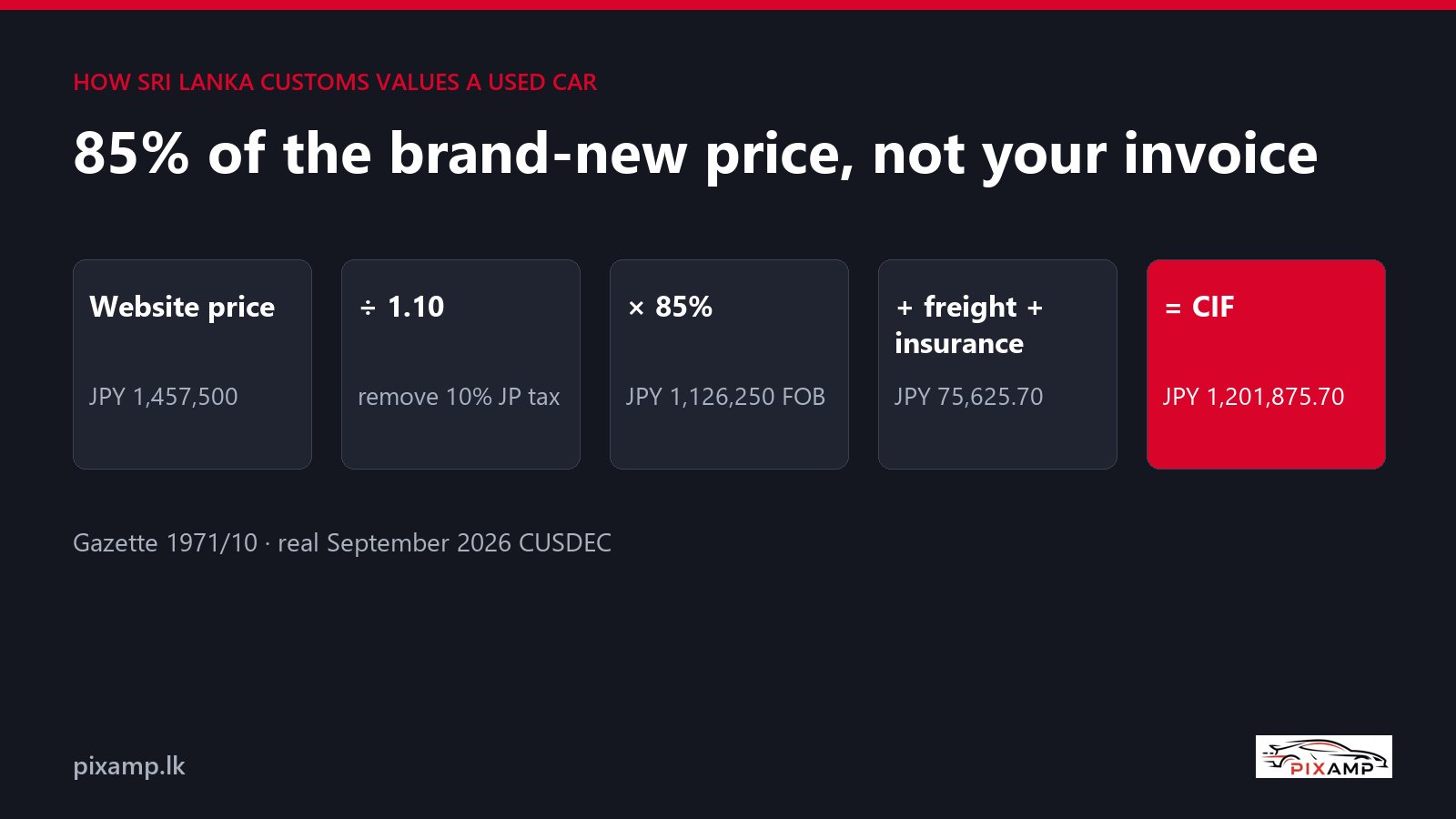
Every import tax on a vehicle in Sri Lanka starts from one number: the CIF value. Many buyers assume that is the price on the seller’s invoice plus freight and insurance. For used vehicles it usually is not. Sri Lanka Customs sets its own value, and on the September 2026 declarations we reviewed that value was higher than the invoice, which raised every tax that follows.
This guide explains the rule and works through a real declaration line by line. Identifying details have been removed; the figures are exactly as printed.
The rule: 85% of the brand-new price, without local taxes
The valuation rule for motor vehicles was set by Gazette Extraordinary No. 1971/10 of 14 June 2016:
- Brand-new vehicles are valued on the manufacturer’s invoice.
- All other vehicles, including used and “recondition” vehicles, are valued at not less than 85% of the manufacturer’s value, excluding local taxes, of a similar or identical brand-new vehicle in the country of export.
In practice Customs takes the brand-new price, removes the exporting country’s own taxes, and applies 85%. If the invoice you paid is lower than that, Customs uses its own figure.
A real example: a 2026 Suzuki Wagon R from Japan
The declaration (CUSDEC) for a 2026 model 658cc petrol Wagon R shows the whole calculation in box 31:
| Step | What Customs did | Value |
|---|---|---|
| 1 | Manufacturer’s website price in Japan | JPY 1,457,500 |
| 2 | Remove Japan’s 10% consumption tax (÷ 110 × 100) | JPY 1,325,000 |
| 3 | Apply 85% → assessed FOB value | JPY 1,126,250 |
| 4 | Add freight from the bill of lading | JPY 70,625.70 |
| 5 | Add insurance | JPY 5,000 |
| CIF value | JPY 1,201,875.70 | |
| 6 | × exchange rate on the CUSDEC (Rs. 2.1522 per yen) | Rs. 2,586,676.88 |
Step 2 is the “excluding local taxes” part of the rule: Japanese list prices include the 10% consumption tax, so Customs divides by 1.10 before applying 85%.
The freight was invoiced in US dollars: USD 452.21 × Rs. 336.1284 per dollar gives about Rs. 152,001, which is JPY 70,625.70 at Rs. 2.1522 per yen. Everything is converted into the invoice currency first and then into rupees once, at the rate shown in box 23 of the CUSDEC.
Invoice price versus Customs value
The same declaration also records the invoice FOB price: JPY 1,050,000. Customs did not use it, because its own assessed FOB of JPY 1,126,250 was higher.
Using the PiXAMP calculator with both values (same car, rates in force in September 2026):
| Using the invoice FOB | Using Customs’ value | |
|---|---|---|
| CIF in rupees | 2,422,571.63 | 2,586,676.88 |
| Customs Import Duty + surcharge | 1,090,157.23 | 1,164,004.59 |
| Excise duty | 1,992,000.00 | 1,992,000.00 |
| VAT (18%) | 1,034,457.49 | 1,080,242.85 |
| SSCL (2.5%) | 143,674.65 | 150,033.73 |
| Total taxes | 4,279,289.37 | 4,405,281.18 |
The valuation difference alone added about Rs. 126,000 of tax. The Customs assessment notice for this car charged Rs. 4,405,283 in total, within Rs. 2 of the calculator (Customs rounds each line to whole rupees).
Excise duty did not change because a petrol car under 1,000cc pays a fixed minimum of Rs. 1,992,000 at this size. For larger engines excise is per cc, so it does not depend on the CIF at all; but Customs duty, the surcharge, VAT, SSCL and any luxury tax all rise with the CIF.
Why the gazette number appears on your CUSDEC
Box 44 of each vehicle CUSDEC we reviewed carries the line “GAZETTE: 2421/44 OF 31.01.2025”. That is not a tax rate. It is the Imports and Exports (Control) Regulations that lifted the suspension on vehicle imports from February 2025. Among other conditions, they require:
- Customs to record the gazette number and the CIF value in boxes 44 and 46 of the declaration;
- the vehicle to be registered within 90 days of the CUSDEC date, with a late fee of 3% of the CIF value per month (capped at 45% of the CIF) after that;
- importers who are not registered vehicle importers to bring in only one vehicle in any 12 months.
So the CIF value in box 46 matters beyond Customs: it is also the base for any late registration fee.
Is the 85% rule changing?
Possibly. In June 2026 the Vehicle Importers Association of Sri Lanka warned that the 15% reduction (the gap between 100% and 85%) was being removed, which would raise used-vehicle values and taxes. In July 2026 the Sunday Times reported that the United States had complained to the WTO about Sri Lanka’s valuation and taxation of used vehicles, and that officials were considering a gradual change.
However, every Customs assessment we reviewed from 22–23 September 2026 still applied the 85% factor. Until a new gazette is published, assume 85%, and confirm the current practice with your clearing agent before you open a letter of credit.
What this means when you use a calculator
- Use the Customs value, not the auction or invoice price. Ask your agent or exporter for the manufacturer’s brand-new price, divide by 1.10 for a Japanese car, multiply by 0.85, then add freight and insurance.
- Convert at the Customs exchange rate. It changes regularly; the CUSDEC shows the one used.
- Enter the result as the CIF in the PiXAMP import tax calculator to see every tax line.
Sources
- Gazette Extraordinary No. 1971/10 of 14 June 2016 (valuation of motor vehicles), as summarised in Daily Mirror, 17 June 2026 and Sunday Times, 5 July 2026.
- Imports and Exports (Control) Regulations, Gazette Extraordinary No. 2421/44 of 31 January 2025 (regulation text).
- A real CUSDEC and Customs assessment notice for the vehicle above (September 2026), identifying details removed.
These figures are for guidance. Valuation practice and rates change; confirm the final amount with Sri Lanka Customs or a licensed clearing agent.