
“How old is the car?” sounds like a simple question, but for an import to Sri Lanka the answer decides two things: whether the car can be imported at all, and, for electric and e-SMART cars, how much excise duty you pay. A few days either side of a boundary can cost millions of rupees, or leave you with a car that has to be shipped back.
This guide explains how the age is measured, from the regulation itself, and what it means for petrol, hybrid, electric and e-SMART cars.
The rule: date of manufacture to the Bill of Lading
The Imports and Exports (Control) Regulations that lifted the vehicle import suspension (Gazette Extraordinary No. 2421/44, 31 January 2025) define age in Regulation 7:
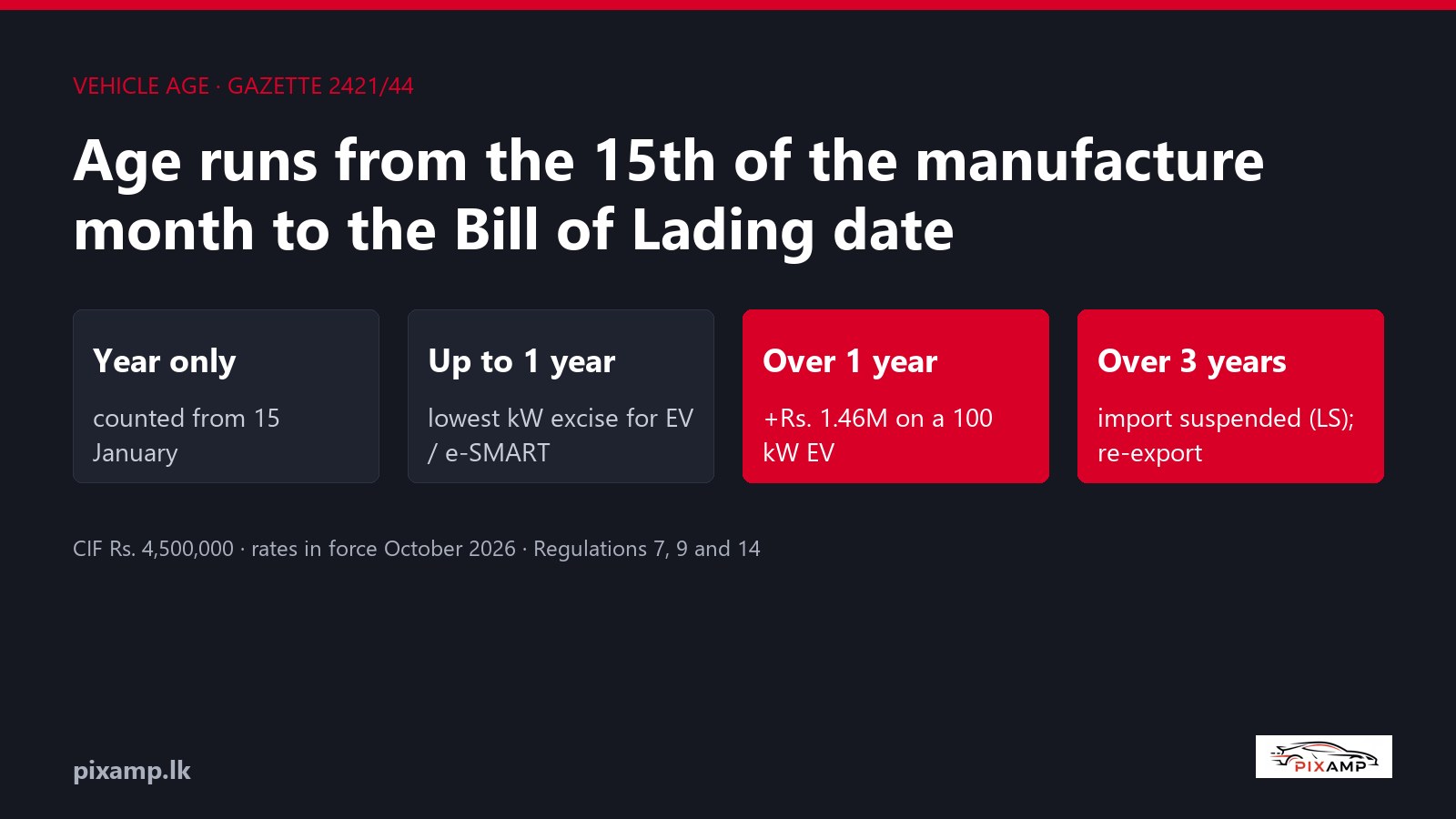
The age of a motor vehicle for the purpose of these Regulations shall mean the period between the Date of Manufacture (Mentioned either in the Manufacturer’s Certificate or Export Inspection Certificate …) and, date of the Bill of Lading or Airway Bill of that motor vehicle.
Two details in Regulation 14 matter:
- The Date of Manufacture is the 15th of the month shown on the Manufacturer’s Certificate or the Export Inspection Certificate.
- If the certificate shows only the year, the Date of Manufacture is taken as 15 January of that year.
So the age is not the model year, not the year you see on an auction listing, and not the day the car arrives in Colombo. It runs from the certificate date to the date of the Bill of Lading (or Airway Bill), the document issued when the car is shipped.
Three examples
| Certificate shows | Date of Manufacture | Bill of Lading | Age |
|---|---|---|---|
| March 2023 | 15 March 2023 | 10 March 2026 | Not more than three years |
| March 2023 | 15 March 2023 | 20 March 2026 | More than three years |
| 2023 (year only) | 15 January 2023 | 1 February 2026 | More than three years, even if the car was built in December 2023 |
The third row is the trap: a certificate that gives only the year makes the car up to eleven months “older” than it really is. Ask your exporter for a certificate that states the month.
The three-year limit on cars
The 2026 Sri Lanka Customs tariff splits passenger cars into “not more than three years old” and “more than three years old”, and marks the older lines “LS”: Import Control License suspended until further notice. In practice, a car more than three years old on its Bill of Lading date cannot be imported as a normal personal or trade import.
The consequence of getting it wrong is severe. Regulation 9 of Gazette 2421/44 says a vehicle imported in violation of the regulations shall be re-exported by the importer within 90 days of the CUSDEC, with all associated costs borne by the importer. If a car is close to its third birthday, make sure it is shipped with time to spare; a delayed vessel can push the Bill of Lading date past the limit.
Petrol and hybrid cars: age does not change the tax
For petrol, diesel and ordinary hybrid cars, excise is charged per cc of engine capacity (Gazette 2418/43), and the tariff gives the same per-cc rate whether the car is new or nearly three years old. A 1,496cc petrol hybrid at a CIF value of Rs. 4,500,000 lands at Rs. 14,193,121 whether it is a few months or two and a half years old.
For these cars, age matters only for the three-year limit.
Electric and e-SMART cars: the one-year band
Electric cars (Gazette 2421/42) and e-SMART hybrids (Gazette 2434/04) pay excise per kW of motor capacity, and the rate depends on whether the car is not more than one year old or older. Here is the same CIF value of Rs. 4,500,000 in both bands:
| Car | Not more than 1 year old: excise (Rs.) | Landed cost (Rs.) | Over 1, up to 3 years old: excise (Rs.) | Landed cost (Rs.) | Difference (Rs.) |
|---|---|---|---|---|---|
| e-SMART hybrid (petrol), 78 kW | 3,195,660 | 11,824,645 | 3,388,320 | 12,056,801 | 232,155 |
| Electric, 100 kW | 2,410,000 | 10,877,925 | 3,620,000 | 12,335,975 | 1,458,050 |
| Electric, 101 kW | 3,656,200 | 12,379,596 | 6,100,400 | 15,324,857 | 2,945,261 |
Crossing the one-year line adds about Rs. 1.5 million to a 100 kW electric car, and almost Rs. 3 million to a 101 kW one, because the higher rate applies to every kW and pushes VAT and SSCL up with it. The difference for the e-SMART car is smaller because its two bands are closer together in the 50 to 100 kW bracket.
The excise gazettes use the same “not more than one year old” wording but do not define age themselves. Regulation 7 of Gazette 2421/44 is the only official definition we found, so ask your clearing agent to confirm the dates Customs will use before you open a letter of credit for a car near its first birthday.
A note on calculators
The PiXAMP import tax calculator asks for the year of manufacture and counts whole calendar years from it. That is fine for most cars, but near a boundary it can put a car in the wrong band: a car made in January 2025 and shipped in December 2026 is almost two years old, not one. If your car is close to one or three years old, work out the age from the certificate and Bill of Lading dates as shown above, and choose the year that puts the calculator in the right band.
Before you buy
- Get the Manufacturer’s Certificate or Export Inspection Certificate and check that it states the month of manufacture.
- Take the 15th of that month and count to the expected Bill of Lading date, allowing for shipping delays.
- For any car, stay clear of the three-year line; a car over the limit has to be re-exported at your cost.
- For electric and e-SMART cars, check the one-year line too, and price both bands in the calculator.
- Read importing an electric car and hybrid, e-SMART or petrol for the full kW tables.
Sources
- Imports and Exports (Control) Regulations, Gazette Extraordinary No. 2421/44 of 31 January 2025: Regulation 7 (age), Regulation 9 (re-export) and Regulation 14 (Date of Manufacture), official text.
- Gazette Extraordinary No. 2421/42 of 31 January 2025 (excise on electric vehicles) and No. 2434/04 of 28 April 2025 (e-SMART hybrids), Ministry of Finance.
- Sri Lanka Customs National Imports Tariff Guide 2026, Chapter 87 and its preamble (the “LS” mark), Sri Lanka Customs.
These figures are estimates for planning. Confirm the final amount and your vehicle’s age with Sri Lanka Customs or a licensed clearing agent.