
With imports open again, most buyers have two choices: import a car (yourself or through an importer) or buy one that is already registered in Sri Lanka. The price tag is only part of the decision. Since May 2026 the two routes are also treated very differently when you borrow, and each comes with its own paperwork and risks.
This guide sets out what the official rules say about each route, with worked figures.
The biggest difference: how much you can borrow
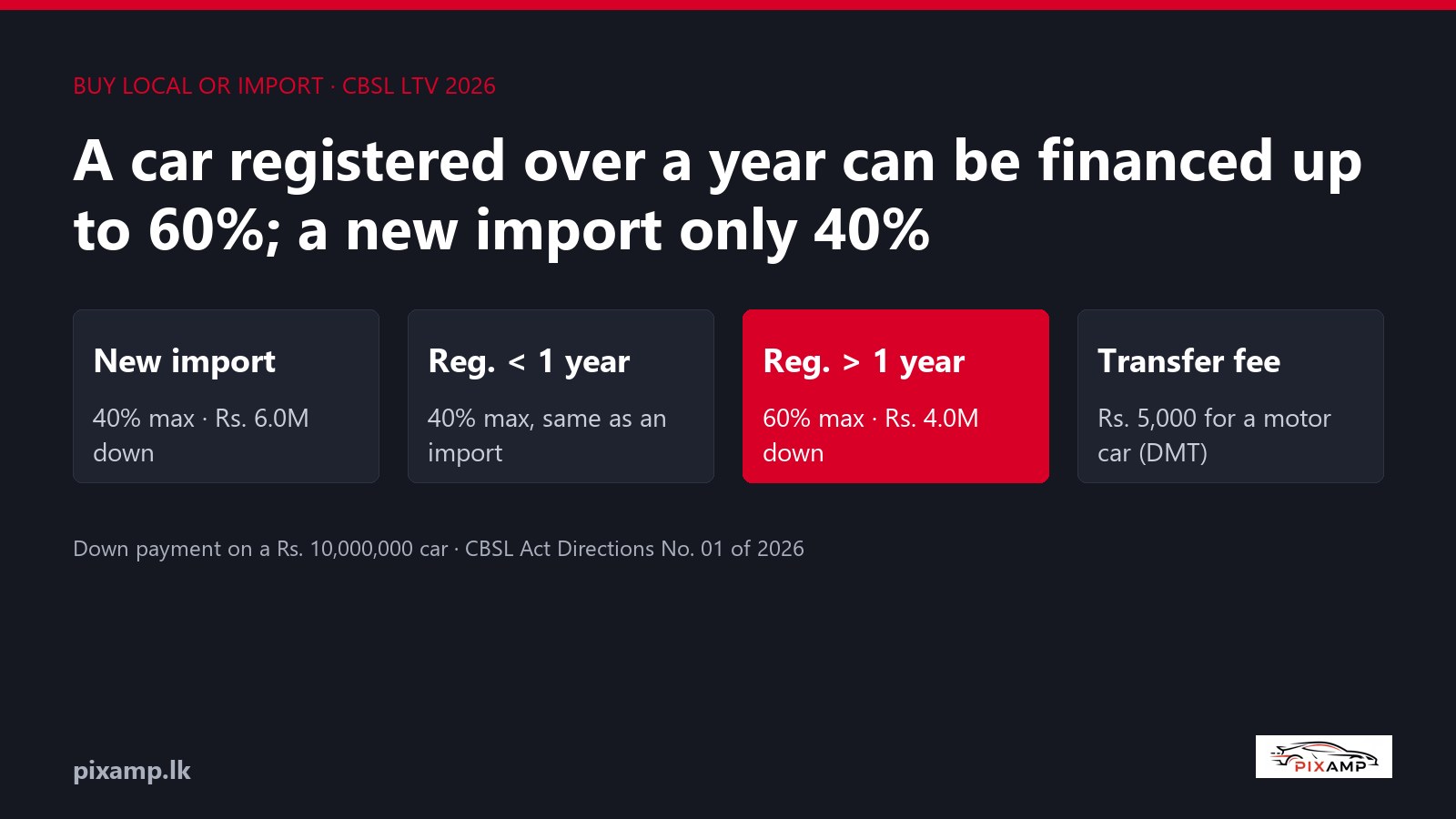
From 25 May 2026, CBSL Act Directions No. 01 of 2026 cap credit for buying a motor car, SUV, van or three-wheeler, by banks, finance companies and leasing companies alike:
| The vehicle is | Maximum financing (loan-to-value) |
|---|---|
| Unregistered (a new import) | 40% |
| Registered in Sri Lanka for less than one year | 40% |
| Registered and used in Sri Lanka for more than one year | 60% |
The cap covers leases, hire purchase, vehicle loans and other credit for buying a vehicle, so changing the product does not change the limit (see leasing vs vehicle loan vs personal loan). Note the middle row: a car registered only a few months ago is treated like a new import.
What that means in rupees
For a car priced at Rs. 10,000,000, financed over 5 years at an example rate of 14% (reducing balance):
| New import or registered under 1 year | Registered over 1 year | |
|---|---|---|
| Maximum financed | 40% | 60% |
| Down payment (Rs.) | 6,000,000 | 4,000,000 |
| Amount financed (Rs.) | 4,000,000 | 6,000,000 |
| Monthly installment (Rs.) | 93,073.00 | 139,609.51 |
| Total interest (Rs.) | 1,584,380.20 | 2,376,570.31 |
The same Rs. 6,000,000 in cash covers the 60% down payment on a Rs. 10 million import, or the 40% down payment on a Rs. 15 million car registered for over a year (financing Rs. 9,000,000, Rs. 209,414.26 a month on the same terms). The rate is an example, not a market quote, and a lender can always lend less than the cap. The Direction uses the vehicle’s market value, so ask the lender how they will value the car you have in mind.
What only an import has to deal with
An import’s price is built mostly from taxes. For the 1,496cc petrol hybrid in our worked example, the CIF value is Rs. 4,800,000 and the government taxes are Rs. 9,923,446, about two-thirds of the Rs. 14,723,446 landed cost. On top of the amount, an import carries risks a registered car does not:
- The 50% surcharge on Customs duty runs until 31 December 2026 (Gazette 2501/88). On that car it is Rs. 720,000 before VAT and SSCL on top of it. See letters of credit and the surcharge.
- The exchange rate on the day Customs values the car moves the whole tax chain (how the exchange rate changes your cost).
- The age limit: a car more than three years old on its Bill of Lading date cannot be imported (how Customs measures age). Older cars are available only on the local market.
- The 90-day registration rule: the car must be registered with the DMT within 90 days of the CUSDEC, or the importer pays 3% of the CIF value per month (the 90-day rule).
- One car a year for private importers: an importer who is not registered with the DMT as a motor vehicle importer may import only one vehicle within twelve months of the CUSDEC date (Regulation 6.3 of Gazette 2421/44).
- Time: you pay before the car is shipped and wait for shipping and clearance.
What only a registered car has to deal with
A registered car is priced by the market, not by a formula, and its taxes were paid when it was first imported. You see the car before you pay. The work moves to checking the car and transferring ownership.
Transferring ownership at the DMT
The DMT’s procedure for a transfer:
- The current registered owner completes all four copies of MTA 6 (A, A1, B and B1), keeps A and A1, and sends copy A to the Commissioner General of Motor Traffic by registered post or by hand.
- The new owner hands in copy B of MTA 6 and copy C of MTA 8 at the DMT’s vehicle transfer section (Colombo 05, a district office, or the relevant Divisional Secretariat) and receives a CMT 52 receipt.
- The new owner keeps copies B1 and C1.
The DMT lists the transfer charge for a motor car as Rs. 5,000 (ordinary service), plus Rs. 150 for stationery and postage, and number-plate charges if the car changes province.
What to check before you pay
- Who is the absolute owner. If the car is on a lease, the finance company is recorded as the absolute owner and must be involved in the sale; the lease has to be settled before ownership can pass to you.
- The registration date. If it is less than a year ago, your lender can finance only 40%, the same as a new import.
- The details on the registration certificate against the car itself: chassis number, engine number and colour. The DMT offers a service for getting the details of a registered vehicle.
- Condition and history, including signs of flood damage (how to spot a flood-damaged car).
Which route suits you
| If you… | Consider |
|---|---|
| Want a specific new model and can wait | Importing, with the landed cost worked out first |
| Have limited cash for the down payment | A car registered for more than one year (up to 60% financing) |
| Want a car more than three years old | The local market; it cannot be imported |
| Are deciding before 31 December 2026 | Whether the surcharge (unless your L/C is exempt) makes waiting worthwhile |
Whichever way you go, price the import in the import tax calculator as your benchmark, then model the installment at 40% or 60% in the finance calculator.
Sources
- Central Bank of Sri Lanka, CBSL Act Directions No. 01 of 2026 (maximum loan-to-value ratios for motor vehicles, effective 25 May 2026), linked from the CBSL press release of 24 May 2026.
- Imports and Exports (Control) Regulations, Gazette Extraordinary No. 2421/44 of 31 January 2025 (Regulations 6.1, 6.3 and 7), official text.
- Department of Motor Traffic, Registration of Ownership Transfer and Charges for Registration of Ownership Transfer.
- Gazette Extraordinary No. 2501/88 of 13 August 2026 (surcharge until 31 December 2026), Ministry of Finance.
This guide is general information, not financial advice. Terms differ between lenders; get every offer in writing.